
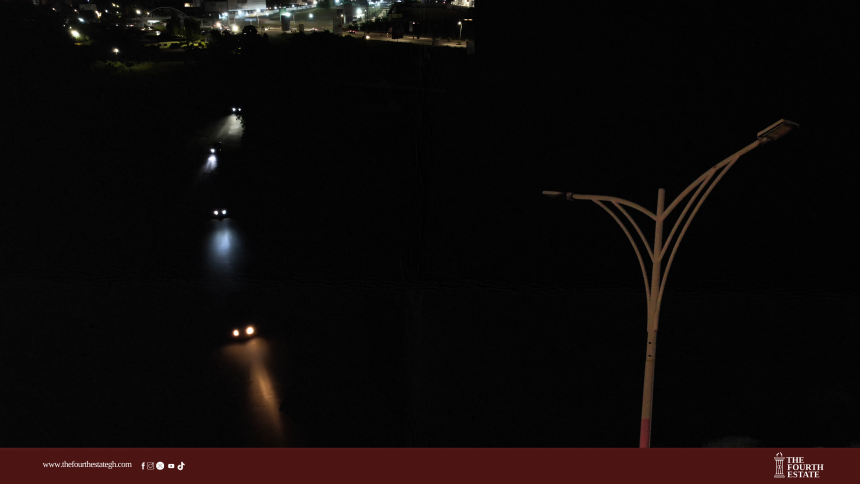
Accra’s streets are lined with shiny metallic poles—evenly spaced, bulbs fitted, wiring in place. At first glance, this looks like a city that planned for the night. But when the sun goes down, the poles stand in pitch darkness. The bulbs do not come on. The only illumination comes from a house set back from the road or the sweeping headlights of a vehicle passing through.
This is more than a minor civic inconvenience; it is a systemic failure.
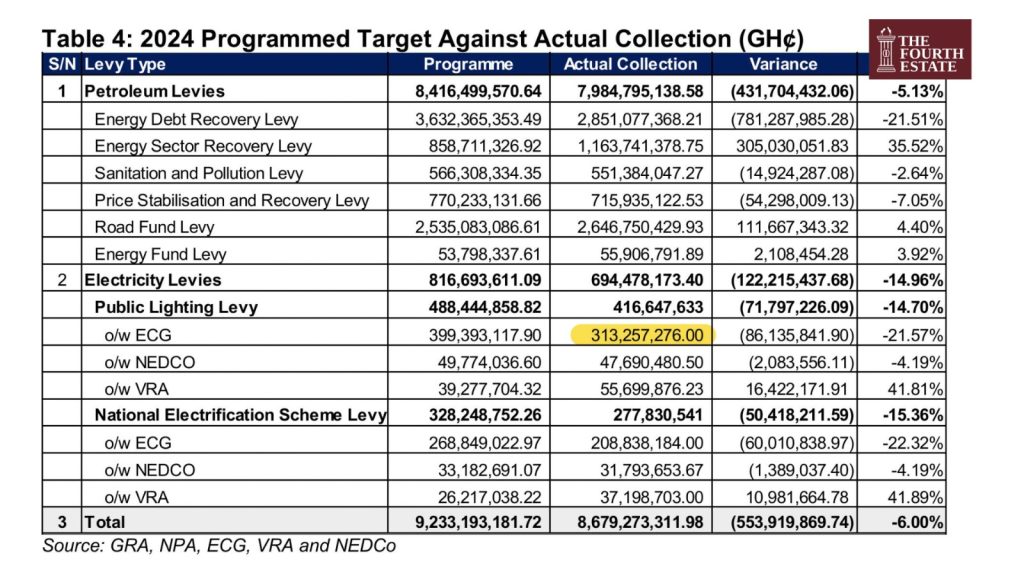
Every time you pay your electricity bill in Ghana, 3% of it goes toward keeping those lights on. You have been paying for it for years. In 2024 alone, Ghanaians paid GH¢313 million under this levy. Yet, the capital remains draped in shadows.
The Night Accra Launched Its “Dubai”
On November 15, 2016, the Kwame Nkrumah Interchange stopped traffic—in the best way possible.
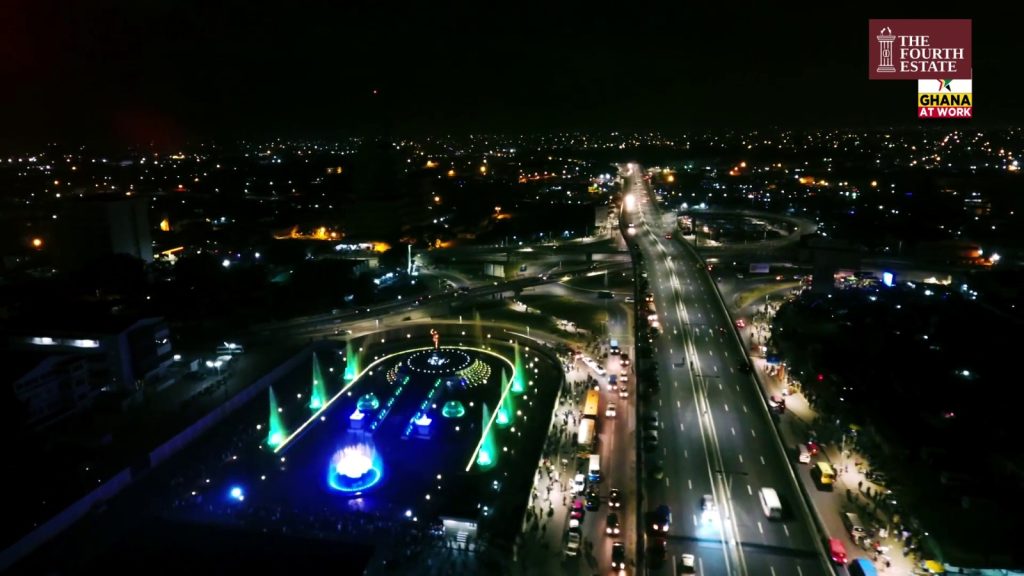
The newly constructed flyover was flooded with state-of-the-art neon lighting, fully functioning streetlights, and a glittering water fountain park at its centre. From the air, it looked like a city reborn. Ghanaians took one look and gave it a name that said everything: Circle Dubai.
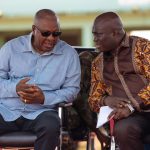
It was more than a road; it was a monument of national pride. President John Dramani Mahama, visibly excited, declared at the commissioning: “My brothers and sisters, it is an honour and privilege on this great day… to declare the Kwame Nkrumah Interchange road project duly opened to traffic.”
Loud cheers followed. But the celebration was short-lived.
By 2017, the lights began to go out quietly. One by one, the neon bars that made Circle Dubai famous dimmed and died. Today, the Interchange is defined by what a vendor who has worked there for years described simply: “After Mahama’s first tenure, just a few months after, the lights went off.”
The water fountain park, once the centrepiece of those opening-night photographs, is now a dark silhouette. The Interchange has not been destroyed; it has been forgotten. Dim, dangerous, and deteriorating, it remains a critical transport nerve centre operating below the most basic safety standards, right in the heart of the capital.
The Paper Trail: Following the Levy
Buried inside every electricity bill in Ghana is a charge called the Public Lighting Levy. Mandated by the Energy Sector Levy Act 946, it collects 3% of your consumption on each billing cycle. The law is explicit about its purpose: to fund and maintain streetlights, traffic lights, and public highway lighting managed by Metropolitan, Municipal, and District Assemblies (MMDAs) across the country.
The money is actively being collected. Official records submitted to parliament by Finance Minister Dr. Cassiel Ato Forson on March 25, 2025, show that the Electricity Company of Ghana (ECG) alone retained GH¢156.63 million of those collections.
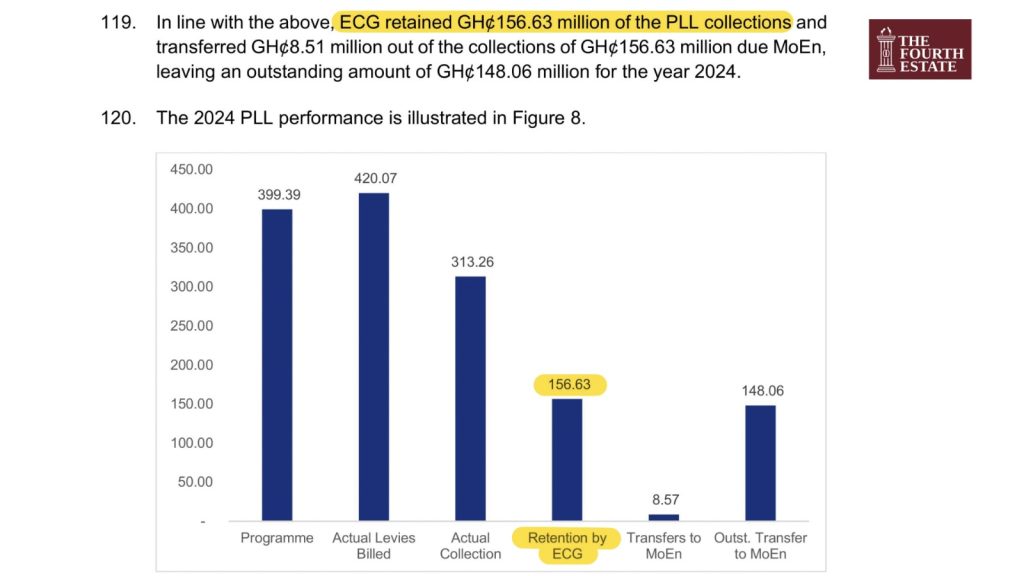
If hundreds of millions of Cedis are sitting in public accounts, why are the streets still dark? Where exactly is the money going?
The Human Cost of Institutional Failure
For vendors at the Interchange, the darkness is not an abstract policy failure. It is an immediate, daily threat.
“Thieves sometimes snatch bags of passersby. Sometimes I team up with friends to retrieve stolen bags,” a driver told The Fourth Estate.
For motorists, the stakes are higher. With no functioning streetlights, drivers resort to using high beams, blinding oncoming traffic, reducing reaction times, and navigating blind spots on roads that were explicitly designed to be lit.
The numbers behind the darkness are stark. The Accra Metropolitan Assembly’s Road Safety Report for 2024 shows deaths from road crashes rose from 88 in 2023 to 118 in 2024. The vast majority of these fatalities occurred between 8:00 PM and 10:00 PM.
Behind every statistic is a human being. One of them was Charles Amissah.
Charles was 29 years old. On the night of February 6, 2025, he was knocked down at the Kwame Nkrumah Interchange around 10:00 PM. He survived the initial impact, but he did not survive the systemic delays that followed at the hospital. His tragic death made national headlines. Today, the lights at the exact spot where he fell remain completely dark.
The Bureaucratic Runaround
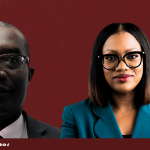
Since her appointment, Greater Accra Regional Minister Hon. Linda Obenewaa Ocloo has made the darkness her signature issue, launching the “Light Up Accra” campaign.
“In 50 days, 70 percent of street lights in Accra will be fixed,” she boldly declared in February 2025.
What followed was a press engagement to inform residents of Accra about the work done so far. She donated bulbs and declared that she had met the 50-day target. Linda Ocloo said 129 streetlights had been repaired. She distributed to all 29 assemblies in December 2025. At one point, her frustration boiled over: “Ghanaians are insulting me—I urge all MMDAs to take the initiative and work.”
On the ground, major roads like the Achimota Overhead, Awoshie Baanyard, and parts of the Hilla Liman Highway remain pitch black. When pressed specifically about the Kwame Nkrumah Interchange, Minister Ocloo stated she was “liaising” with the Ministry of Energy and the Ministry of Roads and Highways, and had summoned the Municipal Chief Executive of the Korle Klottey Municipal Assembly.
The irony here is that the Korle Klottey Municipal Assembly office sits less than 100 meters from the Interchange. The officials responsible for those lights can literally see the darkness from their office windows.
When The Fourth Estate questioned Richmond Rockson, Head of Communications at the Ministry of Energy and Green Transition, regarding coordination with MMDAs, the response was:”The Ministry of Energy and Green Transition coordinates the bulk procurement and distribution of street lighting equipment to MMDAs throughout the year to support rehabilitation, replacement, and maintenance activities. In addition, periodic turnkey street lighting projects are undertaken on selected roads and streets within MMDAs across the country. The MMDAs typically participate in project implementation through routine site monitoring visits, progress review meetings, and the eventual takeover of completed infrastructure. Furthermore, under recently introduced Operations and Maintenance contracts, MMDAs are being trained in the supervision, maintenance, and operation of these assets.”
The ministry procures and distributes street lighting equipment. The MMDAs are trained, yet the roads are dark.
The next time you navigate the Kwame Nkrumah Interchange at night, look up.
The physical infrastructure of a functioning city is all there: tall, evenly spaced metallic poles, fitted with bulbs aimed at the asphalt. What is missing is neither the technology nor the funding. What is missing is the basic accountability to make it work.
The fundamental question is no longer whether Ghana can build. It is whether Ghana can maintain what it has already built. Ghanaians have paid their levies. They have listened to the promises. Now, they are left waiting in the dark for the lights to finally come back on.