
Dawn breaks in Atewa, casting sunlight over what remains of a once-thriving landscape central to human survival. The 263 km² Atewa Forest Reserve in the Eastern Region (once a jewel in Ghana’s ecological crown and the largest reserve closest to Accra) is rapidly shifting from lush greenery into a toxic, muddy wasteland with open brown pits and silt-choked streams.
In January 2026, the forest marked 100 years as a gazetted reserve. At the centennial ceremony, the Okyehene, Osaagyefo Amoatia Oforipanin II, reiterated its original purpose: safeguarding Ghana’s water sources.
Atewa (Atiwa), in the Akyem language, means “the head” — a fitting name for a forest that serves as the source of some of Ghana’s major rivers: the Densu, Ayensu and Birim. These rivers travel far beyond the forest canopy.
The Ayensu flows through Obuoho and Ayensuano to the Kwanyako and Winneba headworks in the Central Region. The Birim supplies the Kyebi waterworks before joining the Pra River.
The Densu travels more than 120 kilometres to the Weija Dam, serving large parts of Accra.
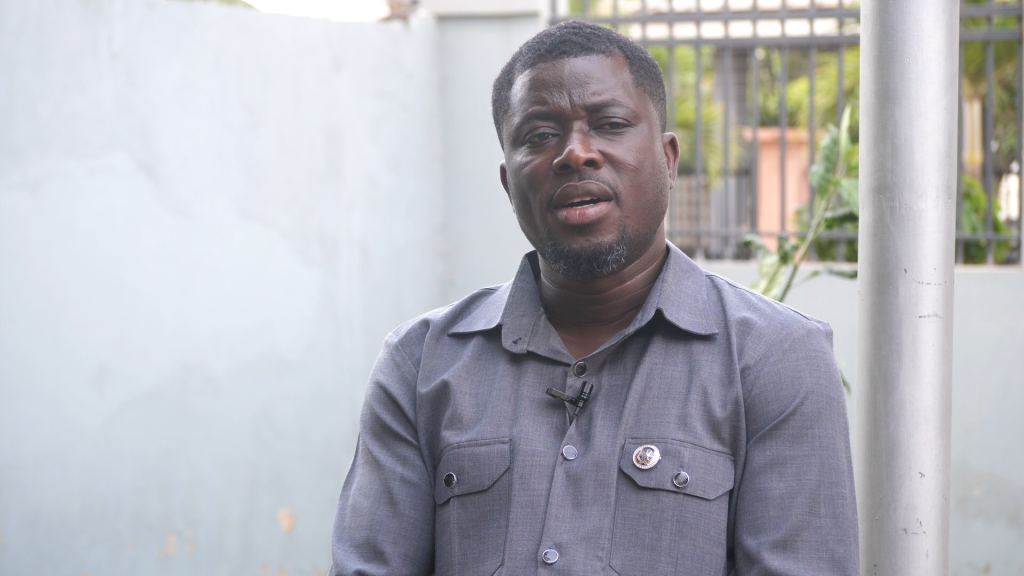
“This is why we all must be concerned with what happens in Atewa,” says Elikem Kotoko, the Forestry Commission’s Deputy Director in Charge of operations.
“Atewa provides water for over five million people,” says Daryl Bosu, environmental scientist at A Rocha Ghana. “As a Globally Significant Biodiversity Area, it is one of the most critical ecosystems in the country.”
A critical forest under siege
Today, Atewa’s critical headwater system is under severe threat. Illegal mining activity has spread across sections of the reserve, tearing through river formation zones and forest cover.
In November 2025, The Fourth Estate documented active mining inside the Atewa Forest Reserve along the Wankobi Stream, a source of the Birim River. The stream had been diverted for gold washing, and wastewater flowed back into the river system.
Drone footage and satellite imagery show extensive damage done in and around the Atewa Forest Reserve. Forest canopy has been stripped away, leaving open pits where streams once emerged clear. Google Earth imagery shows extensive degradation between 2015 and 2025, with visible open pits and bare lands replacing forest cover.
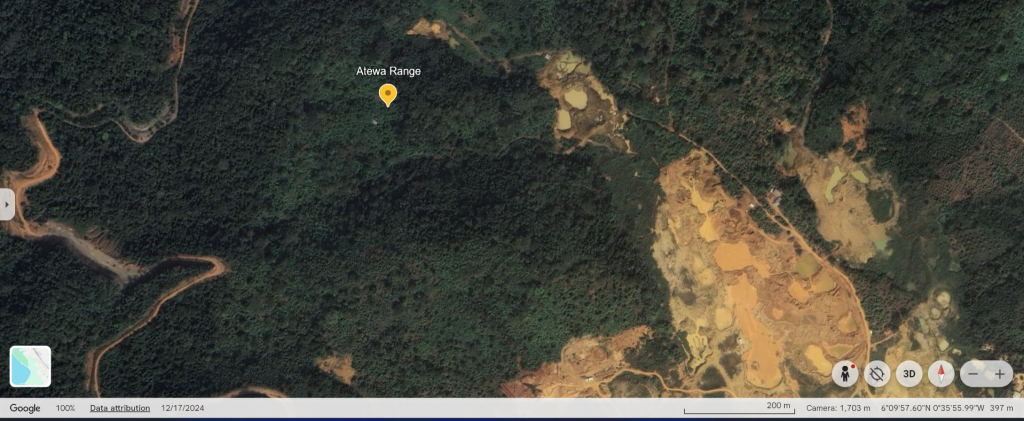
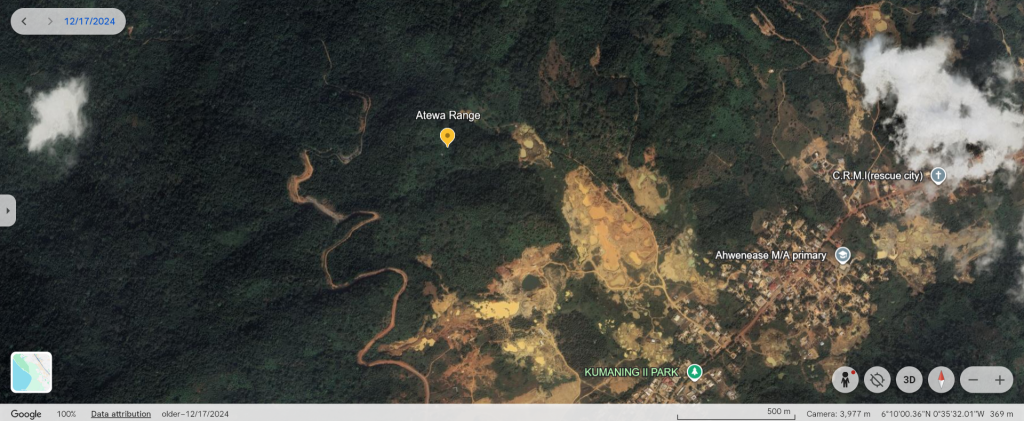
“We have lost a total of 12,000 football-pitch-equivalent forest cover to illegal mining in forest reserves,” says Elikem Kotoko.
Daryl Bosu explains that ongoing destruction disrupts the natural interaction between rainfall, tree canopies, and soil, which is essential for groundwater collection that feeds streams. As tree cover vanishes and topsoil is eroded, rivers experience a decline in both filtration and flow stability. This could cut communities from their water sources permanently.
“We might as well forget about getting water to drink from our rivers if we don’t tackle the issue from the source,” Bosu says.
More concerning evidence is revealed in a study by the University of Environment and Sustainable Development and the Ghana Atomic Energy Commission. The study documents the contents of water samples taken from these rivers as “a toxic cocktail of heavy metals”. Water samples collected at upstream points in Apapamu and Obuoho, where the rivers leave the forest, show high silt loads in areas where groundwater would typically remain clean and clear. Water Resources Commission data also shows water quality fluctuating between fair and poor in these zones from 2020 to 2025.
“Mining inside the Atewa Forest Reserve means the water is already contaminated with heavy metals from the source,” says Humphrey Darko of the CSIR Water Research Institute. “This means even communities without galamsey can be affected.”
These dangers are now the lived experiences of downstream communities several miles in Kwanyako, Winneba, Kyebi and Accra, where treatment plants are struggling with rising turbidity and contamination levels.
The fight to save Atewa
For a 62-year-old retired teacher, Nana Duodu in Segyimase, protecting the Atewa Forest Reserve has been a decades-long struggle.
“We marched 100 kilometres from Atewa to Accra,” Nana Duodu told The Fourth Estate. “And still, previous governments opened up the forest for bauxite mining.”
He points to the now-repealed LI 2462, which allowed forest reserves to be decommissioned for mining exploration.
“When people heard the government was to mine bauxite in Atewa, everyone felt they had to get something from the forest,” Duodu said.
Environmental activist Awula Serwah of EcoConscious Citizens argues that repealing LI 2462 is not enough.
“There has to be political will to fight this menace. Without the will, we kid ourselves,” she says.
Repossession claims and ground realities
Ghana has more than 200 forest reserves nationwide; 50 have recorded incidents of illegal mining encroachment, according to the Coalition Against Galamsey-Ghana and A Rocha Ghana 2026 monitoring reports.
In early 2025, government announced that nine forest reserves had been completely taken over by illegal miners and declared them “red zones.” Officials later stated that all nine, including Atewa, had been repossessed through joint operations by the Lands and Natural Resources Ministry, the Forestry Commission and the National Anti-Illegal Mining Operations Secretariat (NAIMOS).
However, field investigations inside Atewa in November 2025 found active mining within the reserve boundaries.
While NAIMOS reports indicated operations in 16 Eastern Region locations between November and December 2025, documents received from the ministry did not specify permanent deployments inside the Atewa Reserve itself.
Reports published on online platforms of NAIMOS and the Ministry of Lands and Natural Resources, claimed illegal mining had been halted in Atewa and along the Ayensu, Densu and Birim rivers. Sources stationed within Atewa dispute that characterization, stating operations occurred off-reserve.
“NAIMOS’ Atewa operations were a case of misreporting,” Bosu says, referencing observations from A Rocha field officers working in the area.
Both the Ministry and NAIMOS declined interview requests.
What is clear, however, is that NAIMOS’s enforcement officers have publicly cited confrontations with local actors and threats to personnel safety. Sources within NAIMOS told The Fourth Estate that, due to funding limitations, the secretariat had been significantly under-resourced, leading to security and safety risks.

“Because galamseyers have more weapons and know the terrain, it’s often easy to trap and attack enforcement officers,” says Elikem Kotoko. He explains that both the Forestry Commission and NAIMOS, as entities under the Lands and Natural Resources Ministry, grapple with insufficient resources in the illegal mining fight.
A national tragedy and policy shifts
On August 6, 2025, a helicopter crash killed eight people, including Defence Minister, Dr Edward Kofi Omane Boamah, Environment Minister Alhaji Dr Ibrahim Murtala Mohammed, and Acting Deputy National Security Coordinator, Alhaji Muniru Mohammed — high-ranking officials who were central to the war on galamsey.
The tragedy immediately ignited public concern that the absence of these key figures could weaken the already fragile battle against illegal mining. The tragedy intensified fears that momentum would stall, prompting civil society groups and some government actors to argue that only a state of emergency could prevent a deeper regression.
“We have to go radical. It’s not as if we don’t have what it takes to go radical,” the Chief Executive of the Environmental Protection Authority, Professor Nana Ama Brown-Klutse said in an interview in August 2025 on JoyNews.

In September 2025, however, government chose to designate river bodies and forest reserves as national security zones.
“All water bodies and forest reserves are now national security zones, meaning ‘no go’ [areas],” said Lands and Natural Resources Minister Emmanuel Armah Kofi Buah. “We are preparing to deploy permanent security to these zones.”
Yet during field visits to Atewa in November 2025, no visible permanent security presence was observed.