

Designed to digitise public financial management and enhance transparency and accountability, the Ghana Integrated Financial Management Information System (GIFMIS) is increasingly becoming ineffective, according to internal auditors and financial experts. They say deliberate human actions are bypassing and undermining the system’s built-in financial controls, rendering many of its safeguards ineffective.
GIFMIS is an ICT-based Public Financial Management (PFM) platform that was launched in 2010 by the government with the objective of automating the budget preparation, execution, accounting and reporting process of public financial management system.
The use of GIFMIS for processing financial transactions is a legal requirement under Section 25 (6) of the PFM Act, 2016 (Act 921).
A verified World Bank project implementation document on Ghana’s Public Financial Management Reforms between 2015 and 2021 reveals that the project cost the country US$46.7 million. Key among the components of the project was GIFMIS.
Despite these reforms and their associated cost in millions of dollars, the Auditor-General’s annual reports on the management and utilization of the District Assemblies Common Fund (DACF) and other statutory funds have consistently revealed significant financial losses as a result of irregularities.
The reports often reveal unaccounted-for funds, unsupported expenditures, misapplication of funds, overpayment of allowances, and other breaches of public financial management regulations.
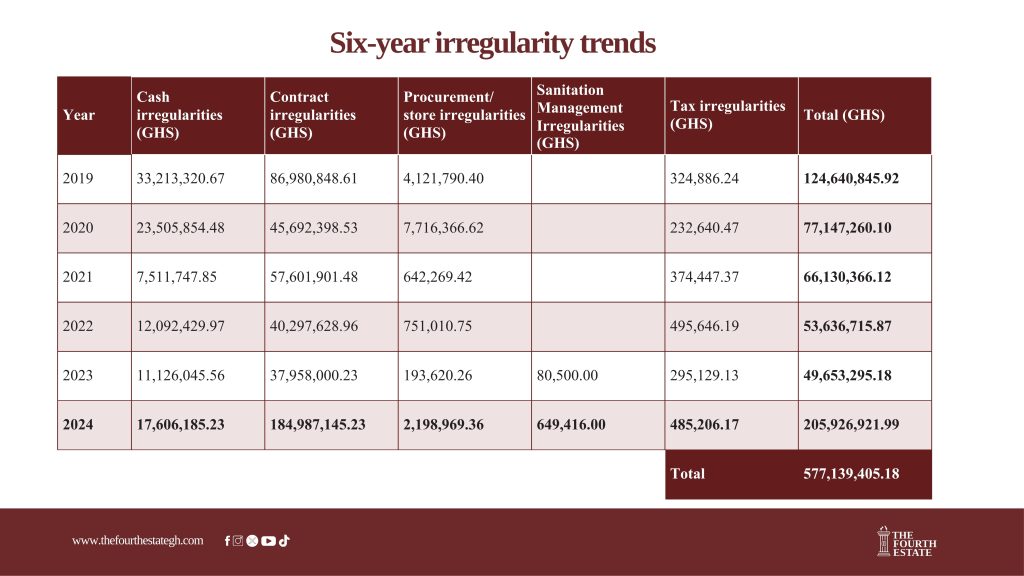
The Fourth Estate’s review of the Auditor-General’s reports on the operations of the Metropolitan, Municipal, and District Assemblies (MMDAs) for six years, spanning 2019 to 2024, shows that irregularities within the assemblies have cost the nation more than GHS577.14 million.
A trend analysis of the data further shows an astronomical increase in irregularities, from nearly GHS 50 million in 2023 to more than GHS 205 million in 2024. This represents an increase of GHS 156. 2 million, or 314.73%.
Counting the cost of GIFMIS bypass
The Auditor-General’s reports covering 2020, 2021, 2022, and 2024 revealed that some spending officers bypassed GIFMIS in processing financial transactions, totaling GHS5.5 million in Municipal and District Assemblies in the Greater Accra, Eastern, Ashanti, and other regions.
A Financial Expert, Nana Amankwa told The Fourth Estate that the pattern of system bypass is not attributable to systemic network failures because GIFMIS infrastructure in Ghana is sufficiently stable to support ordinary operations. Rather, he said the evidence across multiple years suggests that bypass is largely deliberate. “Officers choose to process specific payments off-system precisely because those transactions would attract scrutiny if submitted through the official platform,” he said.
He advised the Audit Service to be deliberate about measuring financial costs and the causes of infractions attributed to system bypass in all its reports.
Mr Amankwah also wants the Service to identify and name officers who commit infractions in its reports and where the offences are committed.
Internal Auditors on why GIFMIS is not addressing issues of irregularities
Some internal auditors who spoke to The Fourth Estate on condition of anonymity said GIFMIS will not achieve its objectives if they (internal auditors) are not granted enhanced access to the system. The said internal auditors are currently only able to see what is fed into the system, unlike principal spending officers, principal account holders, account or finance officers, budget officers, and procurement officers who have unrestricted access to GIFMIS.
“The internal auditor has nothing to do on GIFMIS. You only go there to look into the system but you don’t have access to perform any function,” an auditor remarked.
The auditors also say that, instead of full operationalisation of GIFMIS as a digital platform, there are instances where transactions are done manually. “All memos should be processed through GIFMIS, but in most cases they are prepared manually and only uploaded later.”
Another auditor said “The Controller and Accountant General has given a leeway to the accountants and every month; they go for what they call validation. So, if they are not able to make the payments through GIFMIS, they go for validation and those things are reconciled between them. All these things defeat the purpose of GIFMIS.”
Fear of victimization
The internal auditors say instead of getting their appraisals and promotions from their mother agency – Internal Audit Agency, it is rather the spending officers and principal account holders of the Ministries, Departments and Agencies where they are posted to, who appraise and promote them. This, they say exposes them to intimidation and victimization whenever they challenge certain transactions on GIFMIS.
“The person that you are auditing is the one that will appraise you; either you will get a promotion or not,” one internal auditor said. “The person that you are auditing is the one who gives you the resources to do the auditing, and the person that you are auditing will approve your report for it to be sent. So, at times, you either have to compromise or, you have to be a bit political so that you can get your promotion.”
Domelovo says the system is deliberately chaotic
A former Auditor General, Daniel Yao Domelovo, told The Fourth Estate the issues with GIFMIS are yet another indication that the situation in the public sector is “deliberately chaotic.”
“If you see disorder in the public sector, there’s a lot of order in that disorder,” he said. “It’s chaotic, but people are benefiting from the chaos that has been created.”
Mr Domelovo pointed out that Ghana’s Internal Audit law in its current form is part of the problem, and until it is amended, the internal auditors will continue to underperform even with GIFMIS.
“We must amend the Internal Audit Agency Law, and take the internal auditor out of the control of the principal spending officer, which is the best practice internationally, so that they can be a good check,” he told The Fourth Estate.
“So, when he sees an infraction, he doesn’t fear the Chief Director because the Chief Director of the Ministry of Agriculture or Health or Education cannot demote him, cannot transfer him, cannot impose sanctions on him.”
Audit Service response
In an interview with The Fourth Estate, Assistant Auditor-General, Patrick Neequaye, explained that GIFMIS is structured based on roles and that is why internal auditors are given “read-only” access. He explained that this allows them to see transactions by the scheduled officers for the Directors to approve.
He advised internal auditors to state any issues they encounter in their reports and also state the responses of the principal spending officers. Copies of such reports should be given to the audit committee of the covered entity to deliberate on, while copies are also given to the external auditors and the Internal Audit Agency.
Mr. Neequaye said technological challenges in some parts of the country (such as inadequate human capacity on the use of ICT tools, poor internet connectivity and limited ICT infrastructure) are affecting the effectiveness of GIFMIS.
“Technology is not a one-off thing. You cannot just sit in Accra and say, everybody should go that way,” he said. “There are endpoints where you can centralise or put common items together, but largely, we have to put the technology in the context of how these institutions operate.”
While calling for training to build the capacity of the handlers of the system, he also questioned why Chief Directors at the various institutions do not include their challenges with GIFMIS in their annual reports. “Why are you [chief directors] not publishing in your annual reports the challenges you’re having with GIFMIS? Why are you not writing about it and providing solutions that will be suitable for your entity? So that, as an auditor, once we come across it, we will escalate the problem.”
Mr. Neequaye also said the best way to resolve infractions in financial management in the public sector is through transparency and accountability. “If people handling our resources will be transparent and accountable to us, that would be a very good step,” he stated.
An interview request to the Internal Audit Agency was declined.