

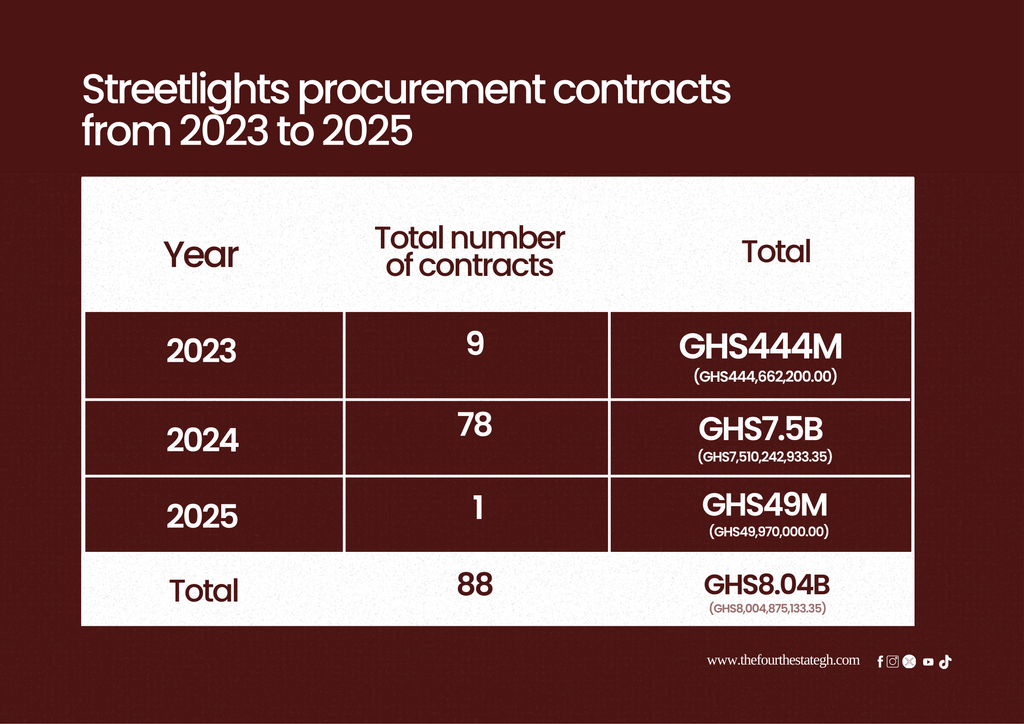
Between 2023 and 2025, the Ministry of Energy and Green Transition awarded contracts worth eight billion cedis to several companies to supply streetlights.
In those three years, the Ministry awarded 88 separate contracts to 25 companies. On average, each contract cost about GHS90 million, yet they were all awarded through single-source tendering.
According to data from the Ministry of Energy and Green Transition, made available to The Fourth Estate through a right to information request, the government awarded nine contracts for the supply of streetlights in 2023 at a total cost of GHS400 million.
In 2024, the number of contracts increased to 78 at a cost of GHS7.5 billion. As of December 2025, the current government had awarded one contract at GHS 49 million.
Billions spent, darkness persists
Despite spending eight billion cedis on nighttime public lighting in just three years, many streetlights are not functioning, and the streets are still dark in the evenings, negatively affecting public safety and security as well as whether the projects have delivered value for money.
In an interview with The Fourth Estate in 2024, the then Director-General of the National Road Safety Authority, David Osafo Adonteng, said that night crashes were very significant in Ghana’s road accident data, pointing out that people were driving into disabled vehicles on major roads at night “because they are unable to see ahead of them.”
The 2024 Accra Road Safety Report also noted that the majority of road traffic fatalities occurred in weekend crashes between 8 p.m. and 12 a.m.
“This pattern may be attributed to high vehicular speeds and reduced nighttime visibility,” the report said. The report recommended visibility interventions to improve lighting at night.
Similarly, a 2024 report by the Kumasi Metropolitan Assembly noted that “improving street lighting, especially when visibility is inadequate, can help to protect vulnerable road users.”
Meanwhile, energy-sector analysts are questioning why many roads remain dark despite the billions of cedis committed to streetlight projects.
For Dr Charles Gyamfi Ofori, Policy Lead for Climate Change and Energy Transition at the Africa Centre for Energy Policy (ACEP), “poor project deliveries and contract variations” are the reason why the country is spending so much on streetlights but has little to show for it.
In his view, Ghana has too many leakages in budget execution processes that facilitate substandard project delivery, mismanagement, and limited supervision.
Auditor-General cites multiple infractions of streetlight procurement
Consistent with Dr Ofori’s view about mismanagement are reports by the Auditor-General (A-G) on procurement and installation of streetlights in Ghana. The A-G’s reports have over the years cited ministries, district assemblies, and government agencies for multiple infractions.
In the report on the public accounts of Ghana as at December 31, 2025, the Auditor-General cited the Electricity Company of Ghana (ECG) for procuring 300,000 units of 120W LED streetlights and 9,620 km of aluminum conductors at a total cost of $127 million—an expenditure that was not included in the approved procurement plan of the company.
A separate audit of the government’s outstanding claims and commitments as of 31 December 2024 found that the Energy Ministry had duplicated GHS399 million in claims for electrical materials, including LED streetlights, arms and bulbs.
The duplication created the risk that the ministry could have paid twice for the same items but for the intervention of the Audit Service.
In the same report, the Auditor-General observed that the Ministry had added to its arrears and commitments as of December 31, 2024, an amount of GHS3.2 billion for the supply and installation of electrical materials under the National Electrification Project. But the audit found that 85% of that amount had already been paid between 2020 and 2024.
Experts believe that the recurrence of these infractions and poor supervision of procurement and installation of streetlights will continue to keep Ghana’s streets dark, even though billions of cedis have been and continue to be spent annually.
Become a member of The Fourth Estate community
For 5 years, we've investigated matters of public interest and helped hold power to account.
Now we're launching our Membership Programme, a community of people who believe independent journalism is worth sustaining, and want to help us do more. Join us as a member, and bring a friend along.
Join the community now
Comments
No comments yet. Be the first to share your thoughts on this story.