
The Centre for Indigenous Knowledge and Organisational Development (CIKOD) says Ghana would be doomed if it allows its agricultural policies to be influenced by foreign interests.
The Deputy Executive Director of CIKOD, Wilberforce Laate, said the decision by governments to enact laws and policies that favour the agricultural practices of other countries rather than local Ghanaian farmers will destroy farming in the country: “If you have policies that do not promote your own agriculture but place power in the hands of others, then we are doomed as a country.”
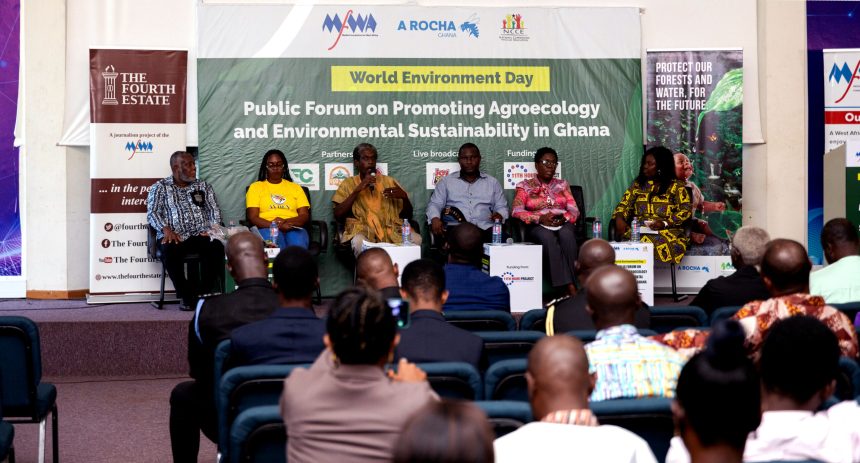
Mr Laate said this at a forum organised by the Media Foundation for West Africa (MFWA) in partnership with A Rocha Ghana and National Commission for Civic Education (NCCE) on Wednesday, June 6, 2024, to commemorate The World Environment Day. The forum was on the theme ‘Promoting Agroecology and Environmental Sustainability in Ghana.’
He raised concerns about the National Biosafety Authority’s (NBA) decision to approve the commercialisation of 14 Genetically Modified products. The Genetically Modified products are made up of eight maize events and six soybean events.
He said when civil society groups kicked against that decision, the NBA said the products were not approved for production in Ghana “but people can import those products into the country.”
Mr Laate said the approved Genetically Modified products “will come cheap” and Ghanaian farmers “cannot compete.” “So, eventually you will destroy your internal agriculture,” he said.
He added that farmers in the country cannot rely on the hybrid seeds being imported into the country because they wither after two to three harvest seasons.
Edwin Baffour, Communications Director for Food Sovereignty Ghana, agreed with Mr Laate. According to him, all the interested parties pushing for the adoption of Genetically Modified products in Ghana are connected to foreign companies and institutions.
“There is nobody in Ghana who is talking about Genetically Modified products who is not affiliated to the research labs or an institution that is getting funding from outside,” he revealed.
Mr Baffour said those interests being advanced are not the core problems facing Ghana’s agriculture.
“Let me tell you, Ghana’s real problem with agriculture is to tackle the fact that there are no roads from the farmgate to the market,” he posited.
Reiterating the prevalence of post-harvest loses in Ghana, Mr Baffour said the government should focus on constructing roads from farmgates to the markets, provide irrigation systems, and build warehouses instead of assisting multinational corporations to take over the country’s agriculture.
“Some of our farmers don’t have money to buy a new cutlass. So, why do you want to put him in a value chain where he must buy certain seeds, and those seeds require certain chemicals to be sprayed on them and a certain type of fertiliser?” he quipped.
The guest speaker at the forum, Professor Alfred Obeng-Yeboah, said policy makers in the country need to device strategies to protect the environment in order to sustain lives.
Prof Obeng-Yeboah, who is the Board Chairman of A Rocha Ghana, bemoaned the excessive use of pesticides and the overexploitation of the country’s biological resources.
“Our land is under stress from climate change, biodiversity losses, and unprecedented levels of pollution from plastics, and immediately you can also assume that our future is unpredictable as a result of these assaults on our land,” he said.
Instead of using agrochemicals to curb pests on their farms, Mr Baffour recommended that farmers could use natural substances such as pepper, garlic and neem tree as pest repellents. He added that farmers can grow chrysanthemum flowers and tobacco next to their plants to repel insects.
In a statement read on his behalf by Dr Kojo Impraim, Director of Research and Advocacy at the MFWA, the Executive Director of the MFWA, Mr Sulemana Braimah, noted that several misconceptions have led to the push back against agroecological farming practices.
He said: “The advocacy for sustainable agroecological practices has been undermined by factors that have included misconceptions that agroecology is against modern technology and inputs in agriculture, and thus, against commercial agriculture.”
He said government policies are focused on boosting yield at all costs. This, he said, has resulted in the difficulty of smallholder farmers to access local seeds and organic farm inputs.
On his part, Kingsley Kwesi Agyemang, representing the Ministry of Food and Agriculture, said the ministry’s policies are in sync with agroecology.
“If you read our new policy that is yet to be published, you will find agroecology as one of the strategies to solve climate change. Whatever we are doing is very much aligned with the policies of the ministry,” he said.
CIKOD’s Mr Laate said it is time for the government to build on existing knowledge about agroecology rather than depending on foreign laboratories and institutions. He said that is the only way for the country to protect its agriculture.
“Look at what happened to us because of the Russian-Ukraine war. Prices of fertilisers skyrocketed because they were not available. So, I’m saying that let’s look at our local policies and reframe our policies to encourage local production. That is the way we can safeguard our agriculture,” he appealed.
Mr Baffour of Food Sovereignty Ghana added that the authorities must adopt and practise the saying that “if you grow your own food, it’s like printing your own money.”
YOU MAY ALSO READ:
Experts urge government to encourage more farmers to adopt agroecology – FULL VIDEO