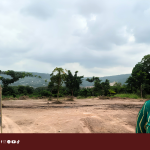

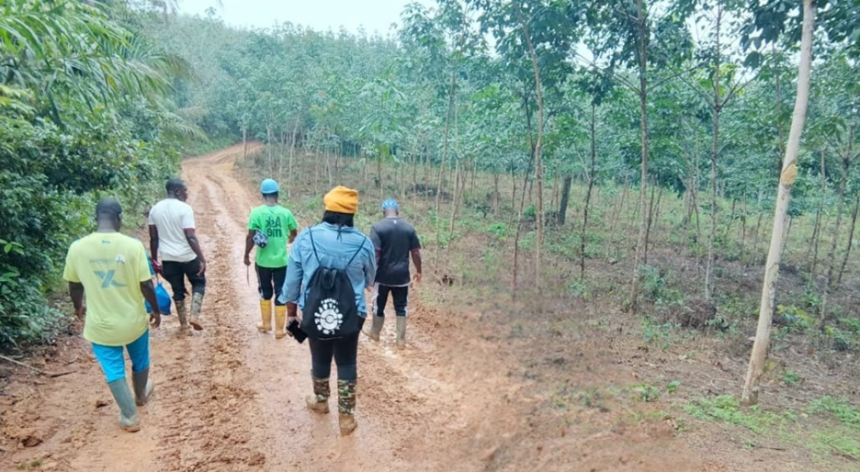
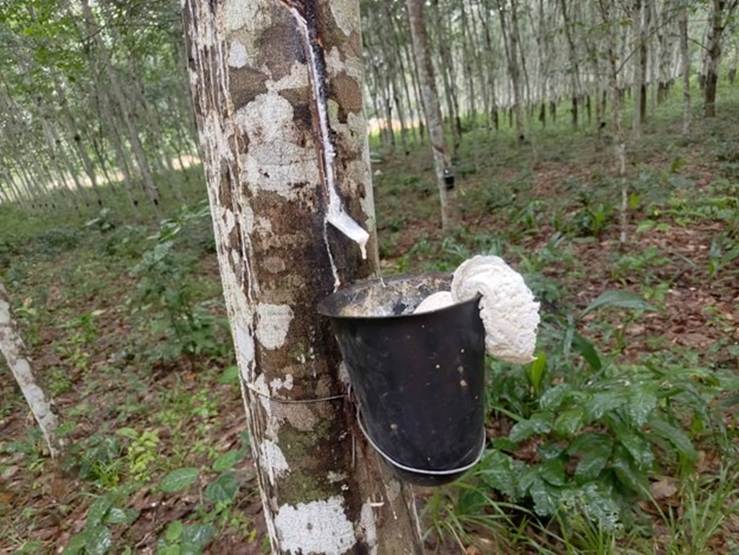
On a muddy stretch of land in Ahanta West in the Western Region of Ghana, a rubber farmer walks through rows of trees he has tended for more than a decade. Latex drips steadily into small cups, but the sense of security it once brought has faded.
“From the start it was good,” Sule, the farmer, recalls, reflecting on years when income from rubber was enough to send three of his children to university. But those years, he says, now feel distant.
“Almost all the farmers I know have to do side jobs now.”
He pauses to inspect one of the cups before moving on. Each drop of latex still represents potential income, but also uncertainty. With younger children still in school, he says the stakes feel higher than ever.
His experience reflects a broader crisis unfolding across the sector. Industry players describe a system under pressure from falling local processing, unstable prices, disputes between processors and traders, and growing volumes of raw rubber leaving the country without value addition.
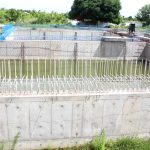
Ghana produces about 100,000 metric tonnes of rubber annually, yet much of it is exported in raw form. This has deprived local factories of the materials they need, despite having a combined processing capacity of more than 178,000 tonnes a year.
The result is a widening gap between potential and reality. The Tree Crops Development Authority (TCDA) estimates that rubber alone could generate up to US$2 billion annually. Combined with other tree crops, the sector could bring in as much as US$16 billion.
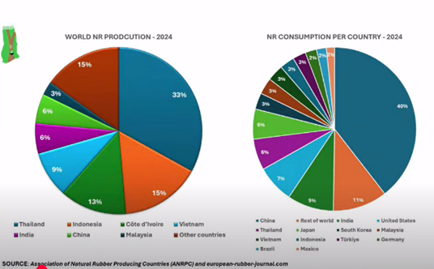
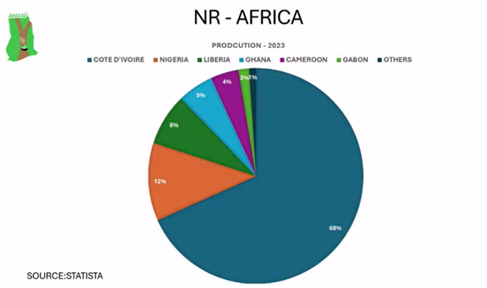
Natural rubber feeds into more than 50,000 products globally, from tyres and footwear to medical equipment and industrial goods, making it a critical commodity in international trade. Around 70% of global demand comes from the automotive sector, underscoring the scale of opportunity for producing countries.
Instead, industry groups say Ghana is losing significant value.
“We are getting less value back into our country because if you export raw rubber per tonne, it’s about US$600, but if you add value, it gets to US$1,500,” President of the Association of Natural Rubber Actors of Ghana, Emmanuel Akwasi Owusu [AD1] stated at the Ghana Industrial summit and exhibition.
“What we are saying is that let’s feed our local processors; if there is excess, then we export.”
The government has acknowledged the imbalance.
In the 2026 budget, the finance minister said measures would be introduced to restrict raw rubber exports and prioritise domestic processing, with the aim of strengthening local value chains.
The policy shift comes at a time when Ghana is under pressure to expand domestic production and reduce reliance on primary commodity exports. For many analysts, the rubber sector represents a test case of whether the country can move up the value chain and retain more economic benefit from its natural resources.
Processors argue that the diversion of raw materials has already had serious consequences. Some say they have reduced operations and laid off workers as supply dwindles, while others warn that continued shortages could force further cutbacks.
“For me, protecting local processing is not only about jobs but also about sustaining investment, ensuring fair competition, and safeguarding Ghana’s economy from illicit financial flows,” says Perry Acheampong of Ghana Rubber Estates Limited, the largest firm in the sector.
He and others in the processing sector say the current situation risks undermining years of capital investment in factories, equipment and community development.
They also warn of changes in farming practices linked to the growing role of independent traders and exporters. Some processors say farmers, seeking quick cash, are tapping trees more aggressively, shortening their productive lifespan from decades to just over a decade in some cases.
Traders, however, reject the criticism. They say exporters have provided an essential alternative market, especially during periods when processors struggled to buy, such as during the Covid-19 pandemic.
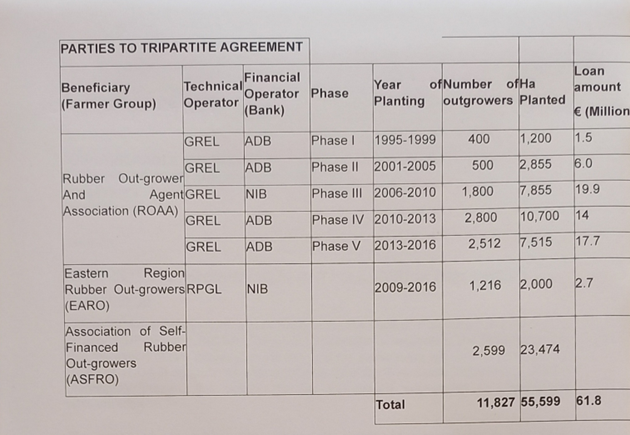
“For us, exporters are a fallback when processors are unable to buy… and subsequently they offer more than the set farm gate prices,” says Bismark Yilaku Essuman, who represents rubber traders under the Rubber Cup Lump Traders and Agents Association.
The higher prices and immediate payment, Mr. Essuman argues, have made exporters more attractive to farmers dealing with rising living costs and limited access to credit.
Behind the dispute lies a deeper issue of trust and incentives. Some processors believe farmers sell outside formal channels to avoid repaying loans or input support.
“Many farmers supply to these agents not for higher prices but to avoid repaying loans,” Mr Acheampong argues.
At the same time, industry leaders warn of growing security and traceability concerns that could affect Ghana’s standing in international markets.
“Harvesters steal the crop from farmers and sell to exporters without checking the source,” says Emmanuel Akwesi Owusu, president of the Association of Natural Rubber Actors of Ghana (ANRAG), adding that this poses security risks in rubber-growing areas.
Traceability is increasingly important for global buyers, particularly in Europe, where regulations require proof that commodities are sourced responsibly and sustainably. Weak oversight in Ghana’s rubber supply chain could therefore limit access to key export markets in the future.
To address such challenges, the government introduced new regulations requiring exporters of raw rubber to obtain permits before shipment, a policy aimed at curbing unchecked exports and supporting local processing.
However, enforcement has been uneven.
Between May and August 2025, raw rubber was exported without the required permits. At Tema Port, customs officials later admitted they were unfamiliar with the new documentation.
“Customs itself was not aware of what the permit looks like until August 2025,” says Amoh Philip of the Ghana Revenue Authority.
This gap meant authorities had limited visibility over the volume of raw rubber leaving the country. The financial impact remains unclear, but the episode has raised concerns about coordination among state institutions and the effectiveness of regulatory reforms.
The lapse also points to a broader pattern of institutional weakness that extends beyond the rubber sector. Analysts have long argued that gaps in enforcement, limited data systems, and poor inter-agency coordination continue to undermine Ghana’s ability to fully benefit from its natural resources.
The consequences are being felt across the value chain. In the Western Region, factories report shortages of raw materials even as farmers complain of low prices and unstable markets.
Local officials warn that the situation threatens Ghana’s industrialisation ambitions. Some describe it as “unacceptable” that factories lack feedstock despite sufficient national production.
For workers in processing plants, reduced operations translate into fewer shifts and, in some cases, job losses. For communities that depend on the industry, the ripple effects can be significant, affecting incomes, local businesses, and social services.
At its core, the crisis reflects competing pressures among stakeholders. The government seeks to protect revenue and enforce regulations. Processors want to safeguard investments and maintain production. Traders argue for open markets and competitive pricing. Farmers, meanwhile, are focused on immediate survival.
Back on his farm, Sule (not his real name) worries about school fees, food prices, and whether rubber will continue to sustain his family in the years ahead. The broader policy debates feel distant compared to the daily challenge of making ends meet.
He says many farmers are now weighing difficult choices, including whether to continue investing in rubber or shift to other crops that may offer quicker or more stable returns.
For him, and many others, the future of Ghana’s rubber industry will depend on whether these tensions can be resolved. Stronger enforcement, better coordination, and fairer market conditions may yet restore confidence in a sector that once promised stability.
Without that, industry players warn, rubber risks becoming another example of lost potential — a resource with the capacity to transform livelihoods, but constrained by weak systems and competing interests.
The author, Juliet Etefe, is a 2025 Fellow of the Next Generation Investigative Journalism Fellowship at the Media Foundation for West Africa.