
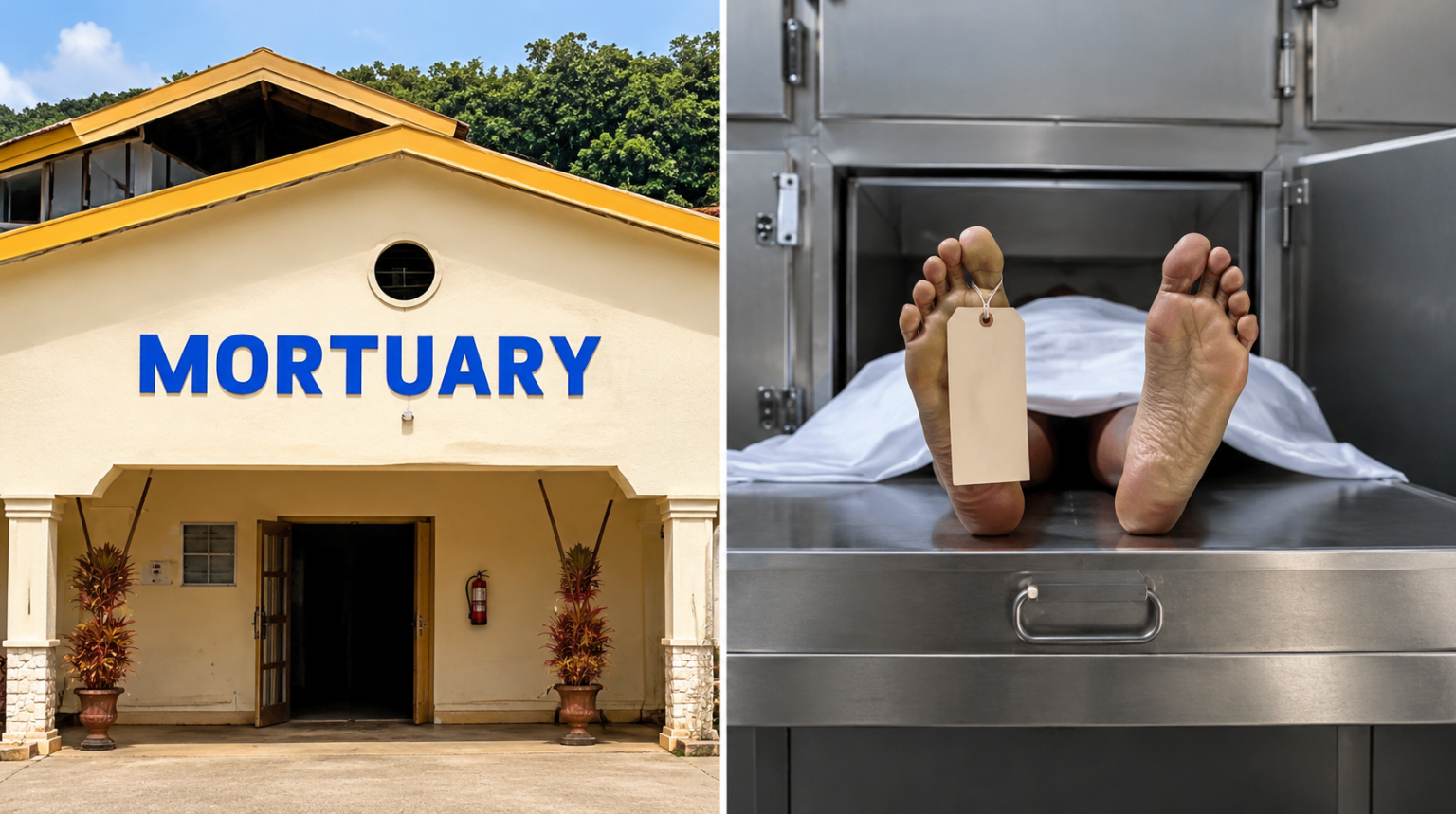
Some dead bodies that were deposited at the Komfo Anokye Teaching Hospital (KATH) in Kumasi in the Ashanti Region for more than 25 years remained unclaimed, occupying valuable storage space and denying the hospital revenue from new admissions.
The unclaimed bodies, included those of chiefs and other royals whose burials have been put on hold because of ongoing litigation, according to a report by the Auditor General.
“We noted that the Mortuary Services Unit repeatedly wrote to central management [of KATH] seeking approval to dispose of the mummified bodies, but these efforts were unsuccessful,” the report says.
While these bodies remained in the morgue, the report said they continued to attract storage costs, resulting in revenue losses to the hospital. However, the mortuary’s management could not provide details of the total mortuary bills for these preserved bodies due to poor record-keeping.
But that is not all. The Auditor General also accused managers and workers of mortuaries in public hospitals of waiving off fees, resulting in revenue losses.
The audit, conducted between July and August 2025, covered the period from 2019 to 2024. It focused on eight healthcare facilities in the Greater Accra, Western, Northern, and Ashanti regions. They were selected because they had large body storage capacities and handle high volumes of human remains.
Auditors reviewed documents and inspected mortuary facilities at three teaching hospitals—Korle-Bu, Komfo Anokye and Tamale Teaching Hospitals; three regional hospitals (Greater Accra Regional, Effia Nkwanta Regional and Tamale Central Hospitals); and two municipal/district hospitals (Pantang and Bekwai Hospitals)
Apart from an initial amount deposited to keep bodies in the morgue, families of the dead only pay the bills when they are about to collect the remains for burial. But with ongoing litigation over some of these deposited bodies, some court cases dragging on for decades, and poor record-keeping, the Auditor-General says many public mortuaries operate at a loss.
Komfo Anokye tight-lipped but Korle Bu reveals cost
The Fourth Estate requested an interview with the Komfo Anokye Hospital in July 2026, asking for details including the cost involved in preserving the bodies, the number of unclaimed mummified bodies in storage, and how the congestion has affected the hospital’s ability to receive new bodies and generate revenue.
But the hospital has been tight-lipped on the matter.
Given that public mortuaries charge the same fees, according to the fees law, The Fourth Estate followed up at the Korle Bu Teaching Hospital mortuary.
The figures show that preserving a body for a year costs approximately GH¢14,500. According to a mortuary official, the daily fee is GH¢25 for the first week, GH¢35 for the second week, and then GH¢40 daily until the body is collected. This suggests that the Komfo Anokye Teaching Hospital (KATH) could be losing thousands of cedis annually for each unclaimed body.
A historical trend
The Fourth Estate found that KATH has a long history with royal bodies that stay in the mortuary for years largely because of chieftaincy disputes and disagreements over burial rights.
In June 2009, the Daily Graphic reported that the late queen of Donyina in the Ashanti Region, Nana Akosua Gyamfua Boahemaa, whose body had been in the mortuary for eight years, was buried on June 11, 2009. In a story with a similar plot, Nana Konadu Yiadom, queen mother of Tafo, who died in April 1995, was buried in November 2002 after a prolonged chieftaincy dispute.
In 2018, Graphic Online reported that 18 members of the Agona Royal Family had been in the KATH mortuary for 13 years because of a family dispute. It was only after the intervention of the Asantehene, Otumfuo Osei Tutu II, that they were buried in November 2022.
More recently, in July last year, some members of the Tafo Royal Family appealed to the Asantehene to intervene and allow the burial of many family members whose burial had been delayed for months because the Tafohene had allegedly prevented them from burying their relatives.
Mass burial
The Auditor General found that long-abandoned bodies are not only worsening congestion at the country’s major referral hospitals but also forcing hospitals to spend public funds on mass burials while losing income that would otherwise be generated with fresh intakes.
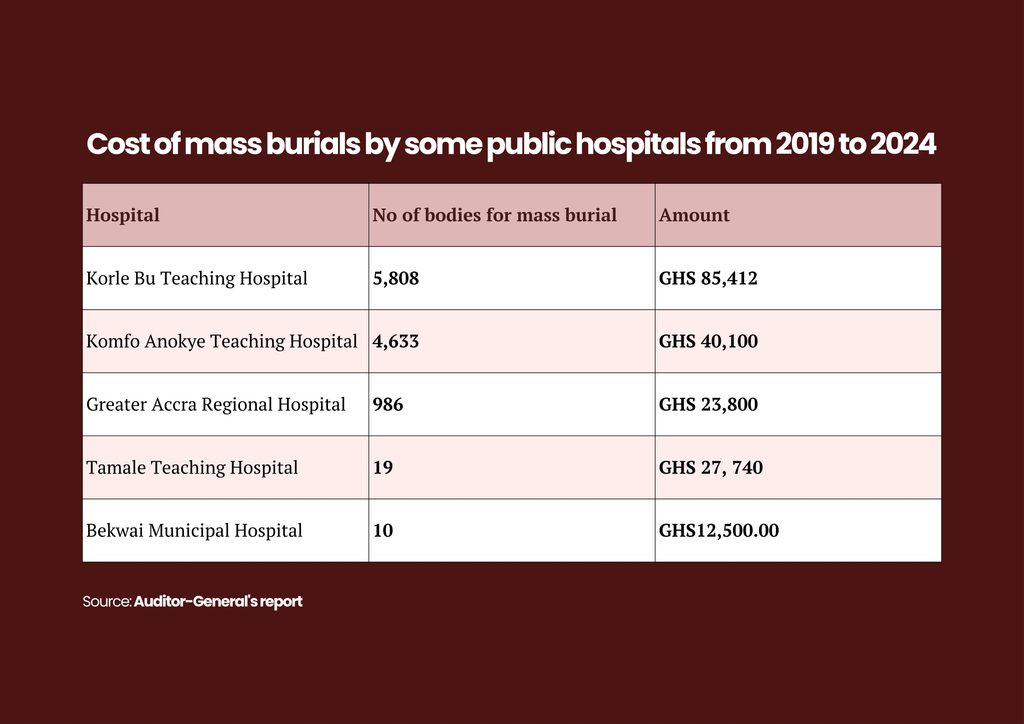
In the last five years, the eight healthcare facilities have spent nearly GHS190,000 on mass burials of thousands of unclaimed bodies, with the Korle Bu Teaching Hospital alone spending GHS85,412 on 5,808 bodies. Bekwai Municipal Hospital spent GHS1,250 per body compared to the Korle Bu Teaching Hospital, which spent only GHS 14.7 per body on mass burials.
Congestion, little dignity for the dead
At the time of the audit, the eight hospitals audited had exceeded their storage capacities.
“Some mortuaries exceeded their approved storage capacity, leading to overcrowding and unsafe conditions,” the report said. “Bodies were often stored on floors or stacked, compromising dignity and increasing health risks. This issue was mainly caused by delays in body collection, poor enforcement of disposal timelines, and insufficient facility expansion.”
For instance, the Korle Bu Mortuary had 148 more bodies than its 457-body storage capacity, while Komfo Anokye Mortuary stored an average of 276 bodies above its capacity of 832.
The report also blamed the absence of mortuaries at other hospitals, and the lack of community and city mortuaries for the congestion in some of the public hospital morgues.
Attendants working without protection
Beyond congestion, the audit uncovered widespread weaknesses in mortuary management across the eight hospitals assessed.
Mortuary attendants were found to be working under hazardous conditions due to inadequate personal protective equipment, limited medical screening, and insufficient training. In some hospitals, attendants handled bodies without the required protective gear, exposing themselves to infectious diseases and hazardous chemicals.
For instance, at the Korle Teaching Hospital, the report stated that although the mortuary authorities complained to the Management of the hospital in May 2021 that they were not regularly supplied with nose masks, gloves, and sanitisers, nothing was done about it.
“As a result, six attendants at KBTH were exposed to Lassa fever [in May 2024] because they did not have disposable coveralls when handling an infectious body,” the report said. “Our inspection at the mortuary confirmed that the attendants were not wearing nose masks, gloves, scrubs, and Wellington boots while performing their duties.
Similarly, mortuary attendants at the Tamale Teaching Hospital mortuary requested PPEs in October 2024 but had to wait until June 2025 to receive them.
The Auditor-General’s report asserted that as they waited, mortuary attendants received and prepared bodies for storage without wearing the required PPE.
“According to the attendants, the absence of these PPEs resulted in them inhaling formalin fumes during embalming, causing headaches, throat irritation, persistent coughing, vomiting, and heartburn,” the report said.
Hospital authorities attributed the unavailability of the PPEs to financial challenges that made it difficult for them to pay suppliers.
To curtail the challenges, the Auditor-General has recommended that hospitals strictly enforce timelines for the collection and disposal of unclaimed bodies, strengthen revenue controls, improve maintenance of mortuary facilities, provide adequate protective equipment and training, while upgrading security and sanitation systems.
Become a member of The Fourth Estate community
For 5 years, we've investigated matters of public interest and helped hold power to account.
Now we're launching our Membership Programme, a community of people who believe independent journalism is worth sustaining, and want to help us do more. Join us as a member, and bring a friend along.
Join the community now
POISONED VEGETABLES: Study reveals high pesticide residues in cabbage, okro sold in two Accra markets

Medical Kalabule 2 : When Doctors profit from patients’ desperation – FULL VIDEO
Medical Kalabule: Ministry of Health to set up probe committee, The Fourth Estate pledges support

Publicly funded but closed to the public: Ghana’s premium hospitals shut out NHIS patients
Comments
No comments yet. Be the first to share your thoughts on this story.