
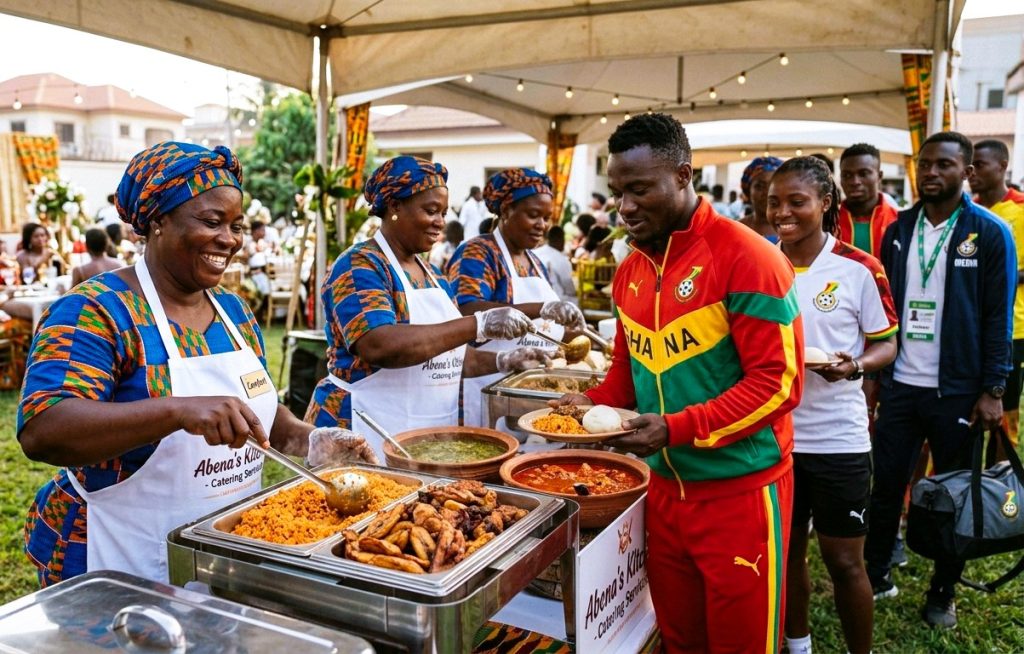
The Auditor-General has raised concerns over a GHS180 million catering contract awarded for the 13th African Games in Accra, questioning how the government arrived at the amount and whether Ghana paid for meals that were never consumed.
The findings, contained in the Auditor-General’s Comprehensive audit on the African Games expenditure, indicate that the catering contract was awarded as a fixed-sum agreement despite uncertainties surrounding the number of athletes, officials, volunteers, media personnel and guests who would ultimately require meals during the tournament.
According to the report, the contract, awarded to catering firm L&M, was valued at GHS180 million ($15 million) and was based on predetermined figures for the number of people to be fed and the duration of feeding.
However, auditors found that the contract failed to state the basis upon which those estimates were calculated.
The report noted that the agreement did not specify the headcount and meal-day assumptions used in pricing the contract, nor did it provide for daily attendance registers, meal tickets, electronic scan logs or any other system to verify how many people actually received meals.
The Auditor-General further observed that the contract did not contain a unit-cost schedule showing the cost per meal, per person or per day, making it difficult to reconcile the total contract amount with actual food consumption.
More worrying, the auditors found no evidence that the agreement included provisions for refunds, deductions or reconciliations in cases where fewer meals were consumed than projected.
Management response
In response to the audit findings, management of the Local Organizing Committee (LOC) and the Ministry of Youth and Sports argued that the contract was based on projections from participating countries, the Association of African Sports Confederations and volunteer registration data.
They explained that athlete registrations remained open until close to the start of the Games, making it difficult to determine exact numbers in advance.
The LOC said it deliberately adopted an “availability-based catering model” under which food services had to remain available at all times to accredited participants regardless of actual attendance at meal times.”
According to management, the contract transferred the risk of fluctuating demand to the contractor and therefore did not require reconciliation against actual consumption.
The response disclosed that officials estimated an average of 200 athletes and officials from each of the 53 participating countries, translating into approximately 10,600 consumers.
Meals were reportedly budgeted at $15 per meal, amounting to $60 per person per day for breakfast, lunch, dinner and snacks over an estimated 23-day period, including early arrivals and late departures.
Beyond the core feeding contract, the Auditor-General also flagged $2.8 million in additional catering-related expenses which were included in L&M’s cost schedule.
They questioned expenses covered categories such as transport and logistics, utilities, infrastructure, staffing and administration.
Auditors indicated that these charges lacked adequate justification and supporting documentation.
The report further stated that some of the services appeared to overlap with work already contracted to other providers, making the expenditure unjustifiable.
“The inclusion of these unsupported items, coupled with clear overlaps with services already contracted to other providers, renders the amount unjustified,” the report noted.
Justification for extra expenses
Again, management defended the expenditure, arguing that extensive additional infrastructure had to be constructed because the kitchen facility available at the Games Village was inadequate for an event of the African Games’ scale.
According to the response, inspections revealed that the existing kitchen was too small to serve the expected 7,520 athletes and officials and lacked sufficient refrigeration, storage, food preparation space and facilities for halal and vegetarian meals.
Officials also cited the fact that the Games coincided with the Ramadan period, requiring special catering arrangements for Muslim athletes and officials. They disclosed that some North African countries had expressed concerns and threatened to boycott the Games if adequate provisions were not made.
Management further stated that additional investments were required for water supply, waste-water management, power supply, refrigeration and temporary kitchen facilities after existing infrastructure was deemed inadequate.
Consequently, the Auditor-General recommended that the amount be recovered from the former Minister of Youth and Sports, Mustapha Ussif; the former Chief Director of the Ministry, William Kartey; and the former Chairman of the Local Organizing Committee (LOC), Dr. Kwaku Ofosu-Asare.
Become a member of The Fourth Estate community
For 5 years, we've investigated matters of public interest and helped hold power to account.
Now we're launching our Membership Programme, a community of people who believe independent journalism is worth sustaining, and want to help us do more. Join us as a member, and bring a friend along.
Join the community now
Controller suspends salaries of over 2,700 public sector workers
Proposed Vice Presidential Villa abandoned for 13 years after over $ 2.4 million spent

Bridge components worth over £43 Million abandoned while communities face dangerous crossings
From Promise to Neglect: What Happened to Koforidua’s €70 Million Regional Hospital?
Comments
No comments yet. Be the first to share your thoughts on this story.